Cricket 26 on Xbox Game Pass: Timing, Licensing, and the Limits of Realism
Streaming Performance: Timing Is Everything
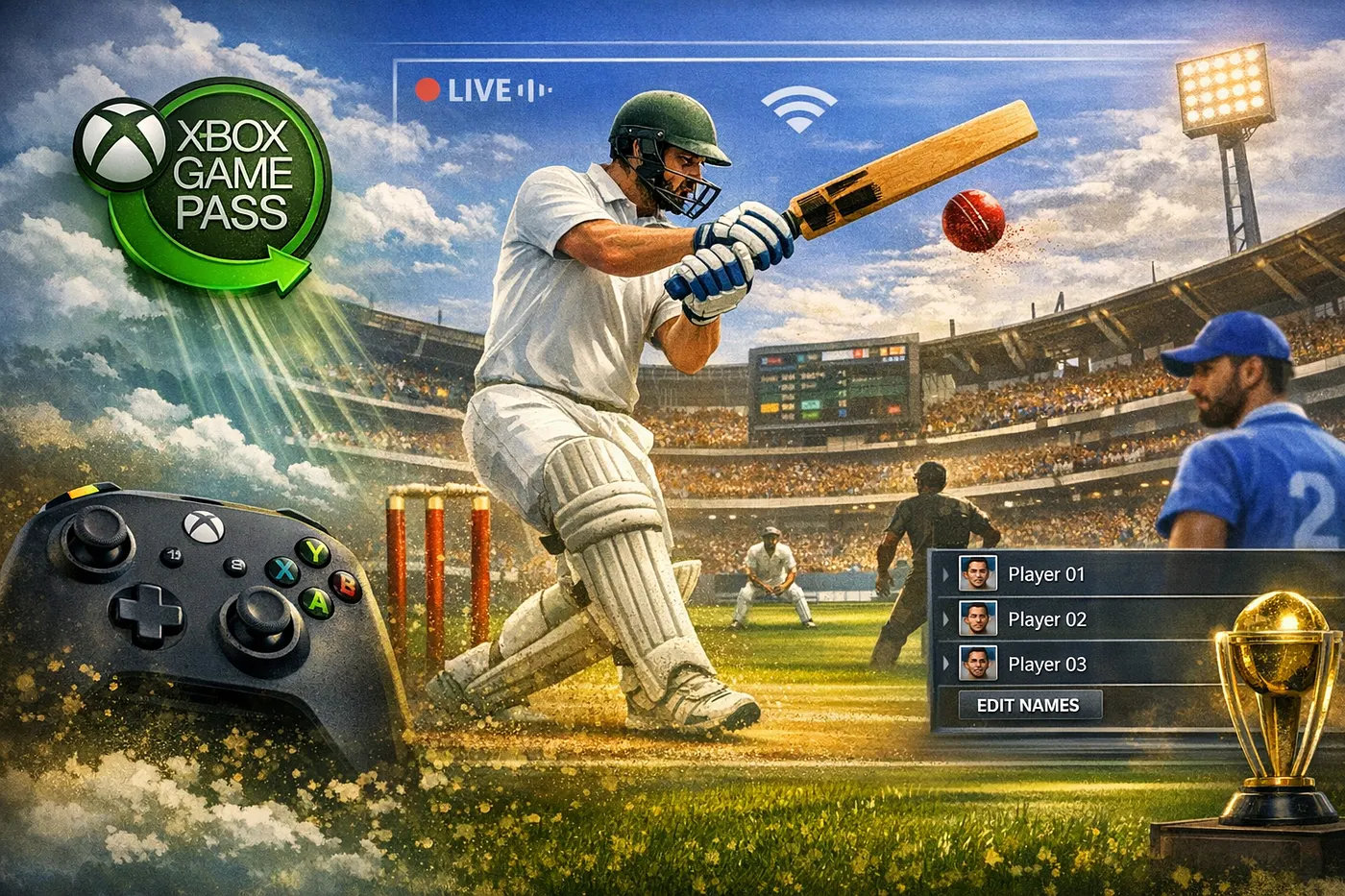
Cricket is a sport where timing defines success, and that precision surprisingly holds up in the streaming version. Batting felt responsive, with no noticeable lag between controller input and on-screen action. The game requires an Xbox controller — keyboard play isn’t supported the way it was in the EA Sports cricket games back in the day — but that’s arguably for the better. The analog sticks probably mimic real shot directions far more naturally than arrow keys ever could.
Licensing and the Community Workaround
Big Ant Studios has long relied on community-driven player name databases to replace the generic ones forced by licensing restrictions. The idea is clever: by letting users upload real player names, the studio sidesteps direct liability under laws using what in the U.S. is known as the Section 230 exemption, which protects platforms from user-generated content.
This time, though, the system didn’t quite work. Connection errors prevented bulk downloads, and the available player lists felt incomplete. In earlier versions, entire tournaments — like the IPL or Ranji Trophy — could be imported. Now, that functionality seems missing. It raises the question of whether Big Ant faced legal pressure to limit the feature. Without authentic names and tournaments, the immersion suffers.
Career Mode: The Balance Problem
As in previous Big Ant cricket titles, career mode is both rewarding and repetitive. Starting with the Kullu club and progressing to Himachal Pradesh’s one-day and first-class teams was satisfying, but the gameplay eventually became predictable. On “Normal” difficulty, once you learn the scoring zones, runs come too easily.
Cricket games face a unique design challenge: balancing realism and engagement. Real cricket involves edges, mistimed drives, and unpredictable outcomes. Too much randomness frustrates players; too little makes the game dull. Cricket 26 leans toward the latter. The Academy mode exists for practice, but I’ve never really used it. Once you master your preferred shots, experimentation stops — and so does the excitement.
The T20 Paradox
Interestingly, the game reinforced a long-held hypothesis: T20 cricket is more bowler-friendly than it seems. In shorter formats, batters must play every ball, increasing risk, and limiting options. That dynamic holds true in Cricket 26 — my player excelled in Tests and ODIs but struggled in T20s. It’s a subtle but accurate reflection of real-world cricketing balance.
Stats and Customization: Still Underdeveloped
For a stats enthusiast, Cricket 26 remains frustratingly opaque. Player statistics in the early stages are lumped together across formats, with no granular breakdowns by bowler type or match conditions. Earlier cricket games had similar limitations, but in 2026, with generative AI and advanced data modeling, this feels outdated. A deeper analytics layer could transform career mode from a grind into a genuine performance tracker.
Captaincy also lacks nuance. You can either autoplay everything or control every decision — there’s no middle ground. Imagine being able to delegate bowling changes or field placements selectively. After years of annual releases, it’s surprising this hasn’t evolved.
Streaming and Accessibility
Game streaming might explain some of these design choices. With players able to jump in and out easily, developers may prioritize accessibility over depth. Cricket games aren’t major streaming draws outside of Commonwealth countries, and my guess is streaming isn’t all too popular outside the United States, but the technology still matters. It makes it easier to start, play, and quit — perhaps too easy.
Multiplayer
I believe game streaming doesn’t allow yet for local multiplayer. That’s a shame — some of my favorite cricket game memories involve playing against a friend. Setting fields and selecting bowlers is a lot more fun when you’re up against a player whose strengths and weaknesses you know and can observe.
Missed Opportunities and Future Potential
I only played as a male batter, though the game includes a robust women’s roster — a welcome feature. The batting mechanics are solid, but the lack of customization options and poor stat tracking limit long-term engagement. A future version could let players fine-tune difficulty curves. It could let you select, for example, the tolerances that lead to nicks; possibly with real-world reference points for players of different levels of skills. It would also let you choose which parts of captaincy you want to engage in, and better statistical tracking. If the legal environment permits then better “community roster” features would be appreciated.
Despite its flaws, Cricket 26 remains enjoyable. According to the Xbox app, I logged 1.1 days of playtime. Those hours were well spent. I’m thrilled I was able to start my career as a player for a club in Kullu. The game’s streaming accessibility makes it easy to drop in for a quick match or continue a career without downloads or updates.
Cricket 26 proves that even niche sports can thrive in the cloud era. It’s not perfect, but it’s playable, accessible, and occasionally brilliant. There’s every chance I’ll drop in from time to time to progress the career of my player and perhaps even try to crack the shorter formats of the game.